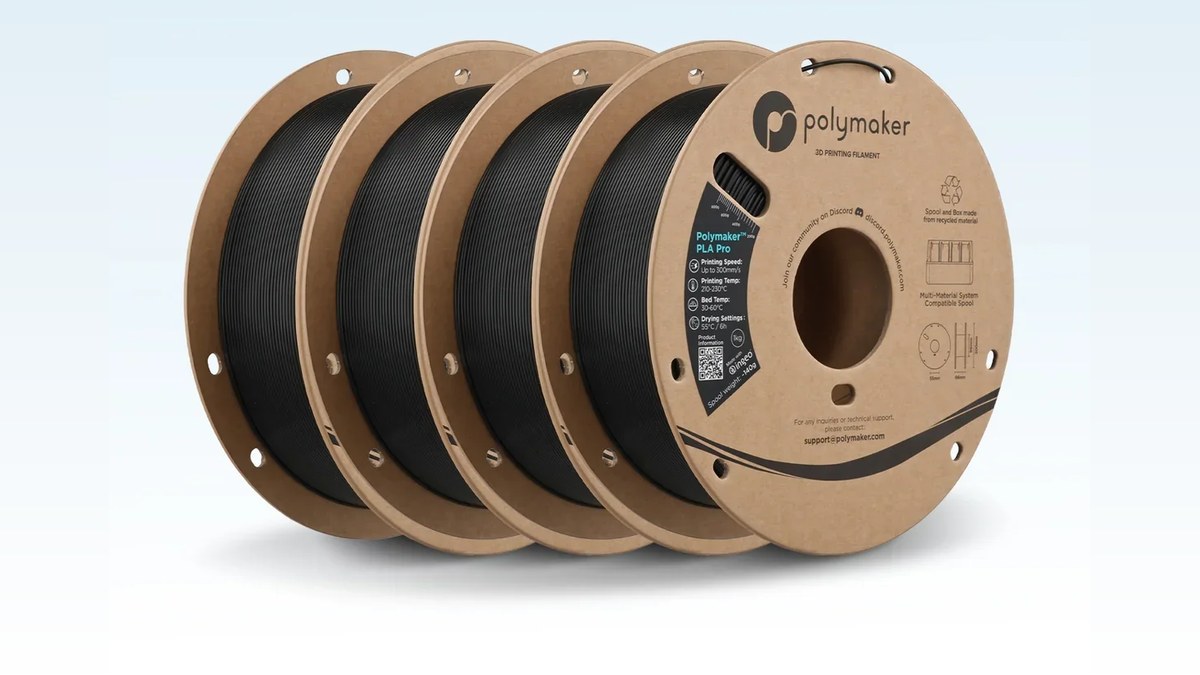
Pictured: Polymaker PLA Pro filament. Image: Polymaker
In this article
San Diego County is suing Polymaker, saying the filament maker deliberately marketed its products to people who 3D print illegal guns. The case is about more than one employee’s hobby, and it raises a real question for the whole printing industry: where does a material supplier’s responsibility begin?
TL;DR
- San Diego County sued Polymaker on October 5, saying it marketed filament to people who print illegal guns.
- Much of the case centers on Polymaker sponsoring, and then hiring, 3D Print General’s Sean Aranda, and making a creator spool of filament with him.
- The county isn’t trying to ban filament. It wants the marketing stopped, the revenue tied to it, and up to $2,500 per violation.
- These are allegations: no court has ruled, and we haven’t found a public response from Polymaker.
My take
Depending on the ruling, I think this case could set a precedent that will be hard to come back from. I’m by no means a legal expert, but there is a difference between an employee having his own hobbies and a company giving that employee his own filament line when it’s fair to assume how it will be used.
Even so, I don’t agree at all that this should be something a company gets sued over. Here in the US, we have constitutional rights. Some states have greatly limited those rights and taken away the right to gunsmith. It’s an odd situation when, depending on how you advertise, you could technically be held to a different standard in each of the 50 states.
Safe to say, I don’t agree with this lawsuit, or with AB 2047, California’s separate bill requiring 3D printers sold in the state to have firearm-blocking technology. It will be interesting to see how this plays out.
There is a big difference between showing that a company supports firearm printing and proving that it knowingly encouraged illegal activity. That difference runs through this whole case, so it’s worth keeping in mind as you read.
What happened
San Diego County announced the lawsuit on October 5, as one of the first three cases from its new Consumer Fairness and Public Protection Unit. The other two target AppLovin and Roblox. The case was filed in San Diego Superior Court in the name of the People of the State of California, against Polymaker LLC.
The complaint accuses Polymaker of violating California’s Unfair Competition Law. The law firm White & Case and the gun-safety group Giffords Law Center are listed as counsel alongside the county.
These are allegations. Filing a complaint does not establish that Polymaker broke the law.
The county’s argument, and why it matters for printing
The case hinges on California’s definition of a “firearm precursor part.” The county argues that filament can fall within that definition when it is marketed to become a firearm frame or receiver, even though filament has countless other uses.
That is the part with possible implications for the rest of the industry. The county is asking the court to look at how a material is marketed when deciding how it should be regulated.
The complaint is explicit about its limits. It says the lawsuit “does not seek to ban the sale of filament in California,” and that the county does not claim all 3D printing filament counts as a firearm precursor part.
The 3D Print General connection
Much of the complaint focuses on Sean Aranda, better known as 3D Print General. According to the complaint, his former YouTube channel centered on 3D printed firearms, and Polymaker began sponsoring it after YouTube demonetized it in September 2023. Polymaker then made a creator spool with him and later hired him as its Head of Customer Experience, a role the complaint says he still holds.
Hiring someone who is part of the firearm printing community doesn’t make every personal video or post the company’s message. The complaint alleges a closer connection than that, including promotional content on Polymaker’s own website.
In paragraph 43, the county says the product page for the 3D Print General spool embedded a video Aranda published announcing it. According to the complaint, the video highlighted the filament’s “flat dark earth” color and showed blurred but recognizable firearms he says he printed with it. We could not retrieve the historical product page to check how it was presented.
That distinction matters. A company choosing to feature content on its own store is a much more direct connection than an employee posting something on his own.
Evidence beyond Aranda
The county also points to material that didn’t come from Aranda’s personal accounts.
Polymaker’s own wiki. The complaint quotes Polymaker’s guide to gluing prints as describing J-B Weld as “popular in functional applications like 3D-printed firearms.” An older search-engine copy of the page matches that wording. The page as it reads today no longer mentions firearms. We could not establish when or why it changed.
Reddit replies. We checked a Reddit discussion the county cites in paragraph 49. Someone in a firearm printing community asked about Polymaker’s PolyMax PLA, and an account named Polymaker_3D replied with a comparison of material properties. The reply exists, but we have not independently confirmed who controlled the account. The reply we reviewed did not explicitly encourage illegal manufacturing; its significance comes partly from where it was posted.
The complaint cites a more explicit exchange in a gun printing subreddit that has since been shut down. There, it says, Polymaker’s account recommended a specific filament in answer to a question about which is better for building guns. We have not independently verified that exchange.
Some evidence is weaker on its own
Other parts of the county’s case are less convincing by themselves. The complaint points to the creator spool’s “flat dark earth” brown color and its “Come and Make It” slogan, a play on the gun-rights phrase “Come and Take It.” It also points to toy guns pictured on product pages and to ordinary marketing about heat resistance, which it calls “coded language” for firearm printing.
That is the county’s interpretation. A color, a slogan or a material spec doesn’t prove unlawful intent on its own. And a customer uploading a photo of a printed gun is a different question from a company choosing that image for an ad.
What the county is asking for
- An order stopping the marketing practices it challenges.
- Revenue Polymaker earned through the alleged unlawful conduct.
- Civil penalties of up to $2,500 per violation, with each day the alleged marketing was available to California audiences counted as a separate violation.
- Attorney’s fees and costs.
These are requests, not penalties a court has imposed.
What’s next
As of October 21, we had not found a public response from Polymaker, and no court has ruled on the allegations. We’ll update this story if that changes.
The open questions are how much of this activity can actually be attributed to Polymaker, and whether that conduct meets the bar of the laws the county is using. Until those are answered, saying Polymaker has been proven to promote illegal gun manufacturing goes further than the evidence does.
Sources
- San Diego County’s announcement (October 5, 2026)
- The complaint, People of the State of California v. Polymaker LLC, linked from the county’s announcement
- Polymaker wiki: gluing guide (cited in the complaint)
- California Senate Judiciary Committee analysis of AB 2047
- Reddit discussion cited in paragraph 49
Header image: Polymaker logo from polymaker.com.