
In this article
Walk into any 3D printing store page and you’ll find dozens of filaments with names like PCTG, ASA and PA12-CF. Most of them will print on a normal home printer. Some need an upgrade first, and a few need real safety precautions. This guide explains every common type in plain English: what it’s good for, what your printer needs, how to print it safely, and which one to buy next.
The quick answer
- New to printing? Start with PLA. It’s cheap, easy, low-odor and prints on every printer.
- Need something tougher? Move to PETG, or PCTG if you want it even tougher. Both print on an open printer.
- Parts that live outside or in a hot car? Use ASA, but you’ll want an enclosed printer with a filter and good ventilation.
- Something bendy like a phone case or gasket? That’s TPU.
Every filament at a glance
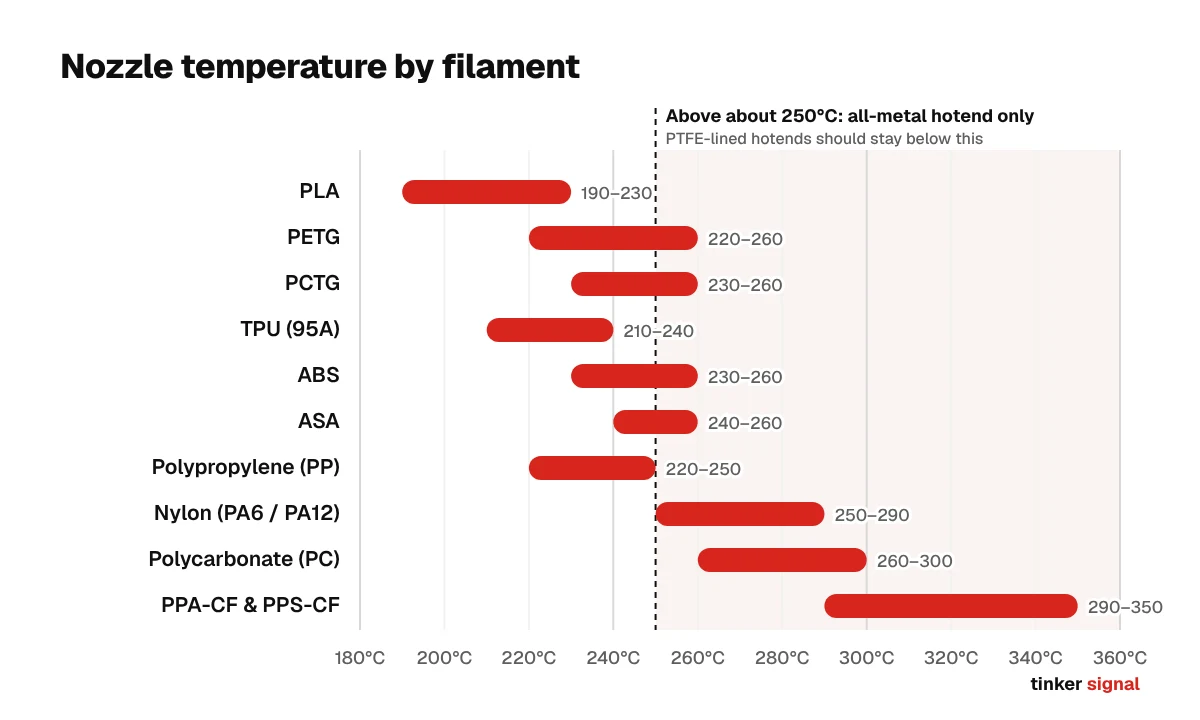
Temperatures are typical ranges. Your spool’s label always wins, because every brand’s recipe is a little different. Safety notes for each material are further down in Printing safely.
| Filament | Difficulty | Nozzle | Bed | Enclosure | Hardened nozzle | Best for |
|---|---|---|---|---|---|---|
| PLA | Easy | 190–230°C | 50–65°C | No | No | Models, prototypes, toys, décor |
| PLA+ / Tough PLA | Easy | 200–230°C | 50–65°C | No | No | PLA that needs to take a knock |
| Silk, Matte & Marble PLA | Easy | 200–230°C | 50–65°C | No | No | Looks: shine, texture, stone effects |
| High-temp PLA (HT-PLA) | Easy | 200–230°C | 50–65°C | No | No | PLA that can handle heat after annealing |
| Lightweight PLA (LW-PLA) | Medium | 200–250°C | 50–60°C | No | No | RC planes, big cosplay props |
| PETG | Easy–Medium | 220–260°C | 70–85°C | No | No | Functional parts, brackets, containers |
| PCTG | Easy–Medium | 230–260°C | 70–85°C | No | No | Tougher, clearer PETG alternative |
| PVB | Easy | 190–220°C | 60–70°C | No | No | Glossy, clear prints you smooth with alcohol |
| TPU (95A) | Medium | 210–240°C | 35–60°C | No | No | Phone cases, gaskets, tires, bumpers |
| Hard TPU (64D–68D) | Easy–Medium | 220–240°C | 35–60°C | No | No | Tough, slightly flexible parts; works in many multicolor systems |
| ABS | Medium–Hard | 230–260°C | 90–110°C | Yes | No | Heat-resistant parts, car interiors |
| ASA | Medium–Hard | 240–260°C | 90–110°C | Yes | No | Outdoor parts that face the sun |
| Polycarbonate (PC) | Hard | 260–300°C | 100–120°C | Yes | No | Very tough, heat-resistant parts |
| Nylon (PA6 / PA12) | Hard | 250–290°C | 70–100°C | Recommended | No | Gears, hinges, wear parts |
| Polypropylene (PP) | Hard | 220–250°C | 80–100°C | Recommended | No | Living hinges, chemical-resistant parts |
| Carbon / glass-filled PLA, PETG & ASA | Medium | 210–270°C | 50–100°C | ASA only | Yes | Stiff, matte-finish functional parts |
| Carbon-filled nylon, PET & PC | Hard | 260–300°C | 80–110°C | Yes | Yes | Strong, stiff engineering parts |
| PPA-CF & PPS-CF | Expert | 290–350°C | 100–120°C | Heated chamber (recommended) | Yes | Near-industrial heat and chemical resistance |
| Wood, metal & glow fills | Easy–Medium | 190–230°C | 50–65°C | No | Yes (metal & glow) | Décor, cosplay, novelty prints |
| PVA / BVOH (supports) | Medium | 190–220°C | 45–60°C | No | No | Dissolvable supports for PLA (BVOH also for PETG) |
| HIPS (supports) | Medium–Hard | 220–240°C | 90–110°C | Yes | No | Dissolvable supports for ABS |
The everyday filaments
PLA
PLA is where almost everyone starts, and plenty of people never need anything else. It prints at low temperatures, barely warps, has very little smell, and comes in more colors than any other material. The catch is heat: PLA starts to soften around 55–60°C, so a PLA part left in a car on a summer day can sag. It’s also a bit brittle. It snaps rather than bends.
Variations you’ll see:
- PLA+ or Tough PLA is blended to be less brittle.
- Silk PLA has a shiny, metallic look but is weaker.
- Matte PLA hides layer lines beautifully.
- High-speed PLA is tuned to melt faster for today’s fast printers.
- High-temp PLA (HT-PLA) prints like normal PLA, then gets baked (“annealed”) in an oven afterward so it handles much more heat. The part can shrink slightly while baking, so test on a small print first.
- Lightweight PLA (LW-PLA or “Aero” PLA) foams up as it prints. Higher temperatures make it foam more, so parts come out up to about half the weight. It’s popular for RC planes and big wearable props, but it strings a lot and takes some tuning.
PETG
PETG is the natural next step. It’s the same family of plastic used in water bottles: tougher than PLA, a little flexible instead of brittle, and good to about 70–80°C. It’s great for brackets, mounts, storage bins and anything that will actually get used. It prints fine on an open printer. The main quirk is stringing, those fine hairs between parts, which usually comes down to drying the spool and tuning retraction. High-flow PETG versions are made for fast printers.
Tip: PETG sticks very well to smooth PEI beds, sometimes too well. Use a textured plate or a thin layer of glue stick as a release layer.
PCTG
PCTG is PETG’s tougher sibling, and it’s quickly becoming a favorite. It prints almost the same way, just a little hotter, but it’s noticeably more impact-resistant, less brittle in the cold, clearer in transparent colors, and absorbs less moisture. If you’ve had PETG parts crack, try PCTG before jumping to an enclosed-printer material. It costs a bit more and there are fewer colors, but that’s changing fast.
PVB
PVB prints much like PLA, with one party trick: wipe or mist it with isopropyl alcohol and the surface melts smooth and glossy, making layer lines disappear. Clear PVB can look close to glass after smoothing. It’s great for vases, lampshades and display pieces. Alcohol smoothing has its own safety rules; see Printing safely.
TPU and other flexibles
TPU is rubbery. Hardness is measured on “Shore” scales. 95A feels like a phone case and is the classic flexible, while softer grades like 85A feel more like a rubber band and are harder to push through the printer. Print soft TPU slowly, and make sure your printer has a direct-drive extruder (the motor sits right above the nozzle). Most modern printers do.
At the other end, hard TPU (around 64D–68D, often sold as “TPU for AMS”) is stiff enough to feed through many multicolor systems while staying tough and slightly flexible. It’s great for grips, feet, protective covers and multicolor prints with bendy parts. Soft TPU usually can’t go through those systems, so load it directly.
The engineering filaments
These handle heat, stress and chemicals that would ruin PLA or PETG, but most of them shrink as they cool, which makes big parts warp and crack. The fix is an enclosed printer that keeps warm air around the print. Several of them also give off noticeable fumes, so ventilation matters here more than anywhere else.
ABS and ASA
ABS is the plastic LEGO bricks are made of. It’s tough, handles around 90–100°C before softening, and can be smoothed to a glossy finish with acetone vapor. ASA is its outdoor cousin: similar to print, but it doesn’t yellow or go brittle in sunlight. If a part lives outside, like a garden fixture, bike mount or car exterior clip, choose ASA.
Safety: ABS and ASA give off styrene fumes and some of the highest levels of ultrafine particles of any common filament. Print them in an enclosed printer, ideally with a carbon and HEPA filter, in a ventilated room, and never in a bedroom or where people sleep.
Polycarbonate (PC)
PC is one of the toughest plastics you can print at home and handles well over 100°C. It needs a hot nozzle (up to 300°C), a very hot bed and an enclosure, and it warps enthusiastically. Blends like PC-ABS are a bit easier to live with. Treat PC like ABS for ventilation, and make sure your hotend (the heated part that melts the filament) is rated for its temperatures (see Printing safely).
Nylon (PA)
Nylon is slippery, tough and wear-resistant, which makes it ideal for gears, hinges and anything that rubs against something else. Its big weakness is water: nylon soaks up moisture from the air within hours, and wet nylon prints bubbly and weak. You’ll need to dry it before printing and ideally print straight from a dry box. PA12 absorbs less moisture than PA6 and is the friendlier of the two. Nylon releases fumes (mainly caprolactam) while printing, so ventilate.
Polypropylene (PP)
PP is the plastic in food tubs and the flip-top hinges on shampoo bottles. It’s light, flexible, shrugs off most chemicals, and can bend thousands of times without breaking, which makes it perfect for “living hinges.” The downside is that it barely sticks to anything, including a normal print bed. You’ll need a PP-specific build surface or packing tape, and it warps a lot. It’s rewarding but not a beginner material.
Carbon fiber and glass fiber blends
When you see -CF (carbon fiber) or -GF (glass fiber) on the label, it means tiny chopped fibers have been mixed into a regular plastic. The result is stiffer and more dimensionally accurate, with a great-looking matte finish. It is not “carbon fiber” in the bike-frame sense, and it’s often a little more brittle than the base plastic.
Those fibers are abrasive. They’ll wear out a standard brass nozzle in a spool or two, so you need a hardened steel nozzle. Many newer printers ship with one; check before you buy.
- PLA-CF, PETG-CF and PETG-GF: the easy entry point. They print like their base plastic, on an open printer, with a hardened nozzle.
- ASA-CF: ASA’s outdoor toughness with extra stiffness. It needs an enclosure, like regular ASA.
- PA-CF, PET-CF and PC-CF: serious engineering parts. You’ll need a hot nozzle, an enclosure, and dry filament.
- PPA-CF and PPS-CF: the top shelf, close to industrial materials in heat and chemical resistance. They need a hardened nozzle that can run around 300°C or hotter, and they print best with an actively heated chamber. PPS-CF in particular really needs one, and only a handful of high-end consumer printers have it.
Safety: Printing fiber-filled filament is fine, but sanding, cutting or drilling the finished parts releases fine fiber dust. Wear a dust mask (N95 or better) and safety glasses, and work somewhere you can clean up with a damp cloth or HEPA vacuum rather than a broom.
Specialty and “fun” filaments
- Wood-fill: PLA mixed with wood powder. It looks and even smells like wood, and can be sanded and stained. Use a slightly larger nozzle (0.6 mm) to avoid clogs.
- Metal-fill: PLA packed with real copper, bronze or steel powder. It’s heavy, polishes to a real metallic shine, and is abrasive, so use a hardened nozzle.
- Glow-in-the-dark: great for kids’ prints and cosplay. The glowing additive is surprisingly abrasive, so hardened nozzles again.
- Color-changing: shifts color with temperature or UV light. It prints like normal PLA.
Support filaments
If your printer can use two materials at once, like a multicolor system or a dual-nozzle printer, you can print supports in a material that dissolves away. PVA and BVOH dissolve in plain water. PVA pairs best with PLA, while BVOH also works with PETG and nylon. HIPS dissolves in a citrus-based solvent called limonene and pairs with ABS. All of these absorb moisture fast, so keep them sealed and dry. A cheaper trick many people use is printing just the contact layer of supports in PETG under a PLA part, because the two don’t stick well to each other and snap apart cleanly.
Printing safely
3D printing at home is safe when you respect a few rules. Melting plastic always releases something: every filament gives off tiny “ultrafine” particles and some gases while it prints, and the amount depends heavily on the material. Here’s what matters.
A note on the science: Some of the risks below are well established: burns, fire, flammable solvents, fiber dust, and overheated PTFE around pet birds. The long-term health effects of breathing printer emissions at home are still being studied. Researchers have measured what printers release, but there isn’t firm evidence yet on what everyday home exposure means for your health. Treat the ventilation advice as sensible precautions rather than proven dangers, check the safety data sheet (SDS) from your filament’s manufacturer, and talk to a doctor if you have asthma or other breathing concerns. This guide isn’t medical advice.
Fumes and ventilation, by material
| Material | Fumes & particles | Other hazards | What to do |
|---|---|---|---|
| PLA, PETG, PCTG, PVB, TPU | Lowest of the common filaments | Hot nozzle and bed | Normal room ventilation; avoid printing where you sleep |
| ABS, ASA, HIPS | High: styrene and lots of ultrafine particles | Warping can pull parts loose mid-print | Enclosure with carbon + HEPA filter, ventilated room, never in a bedroom |
| Polycarbonate (PC) | Moderate to high at its print temperatures | Very hot nozzle and bed | Enclosure with filtration; all-metal hotend |
| Nylon (PA) | Moderate: mainly caprolactam | Very hot nozzle | Ventilate; all-metal hotend above about 250°C |
| Polypropylene (PP) | Moderate | Parts can release from the bed and jam the printer | Ventilate; watch the first layers |
| Carbon & glass fiber blends | Same as the base plastic | Fiber dust when sanding or cutting; wears brass nozzles | Dust mask and glasses when finishing parts; hardened nozzle |
| PPA-CF, PPS-CF | Higher at 300°C+ temperatures | Extreme nozzle, bed and chamber temperatures | Only on printers built for them; enclosure with filtration |
| Metal & glow fills | Same as PLA | Abrasive; not food-safe | Hardened nozzle; keep away from food and mouths |
| PVA, BVOH, HIPS supports | Same as their pairing plastic | Limonene (for HIPS) irritates skin and eyes | Gloves and ventilation when dissolving HIPS |
Know your hotend’s limit
Some printers, especially older and budget models, have a hotend lined with a PTFE (Teflon) tube. PTFE starts to break down when it gets too hot, so these hotends should stay below about 240–250°C. That rules out PC, most nylons and the carbon-fiber engineering blends. The fumes from overheated PTFE are especially dangerous to pet birds, which can die from exposure, so keep birds well away from any 3D printer. If you want to print hot materials, use a printer with an all-metal hotend; most current printers have one.
Smoothing and finishing
- Acetone vapor (ABS, ASA): acetone is extremely flammable and its vapor spreads. Use a small amount in a closed container, outdoors or in a well-ventilated space, far from flames, heaters and anything that sparks. Never heat acetone to speed it up.
- Isopropyl alcohol (PVB): also flammable. Ventilate, avoid flames, and let parts dry fully before handling.
- Sanding any print: wear a dust mask. With fiber-filled materials, add safety glasses.
Is it food-safe?
Usually, no, even when the plastic itself is. The tiny grooves between layers trap food and bacteria and can’t be cleaned properly. Colorants and additives aren’t always food-grade, and brass nozzles can contain small amounts of lead. If you must print something for food, use a filament certified for food contact, a stainless steel nozzle, and a food-safe coating, and treat the part as short-term use only. Cookie cutters used once for dough are fine; a cup you drink from every day is not.
Heat, fire and little hands
- Nozzles run at 200–350°C and beds up to 120°C, hot enough for a serious burn. Keep kids and pets away from a running printer.
- Keep a working smoke detector near your printer, keep the area clear of anything flammable, and check in on long prints, especially on a new or modified machine.
- Keep your printer’s firmware up to date; modern printers have “thermal runaway” protection that shuts off heaters if something goes wrong.
What your printer needs
| If your printer is… | You can print |
|---|---|
| Open-frame, standard brass nozzle | PLA and all its variants, PETG, PCTG, PVB, TPU (soft and hard), wood-fill, color-changing, PVA and BVOH |
| Open-frame, hardened nozzle | All of the above, plus PLA-CF, PETG-CF, PETG-GF, metal-fill and glow-in-the-dark |
| Enclosed, all-metal hotend | All of the above, plus ABS, ASA, PC, nylon, polypropylene and HIPS |
| Enclosed, hardened nozzle, 300°C+ hotend | All of the above, plus ASA-CF, PA-CF, PET-CF and PC-CF |
| Actively heated chamber, 300°C+ hotend | Everything on this page, including PPA-CF and PPS-CF |
One habit that fixes most problems: keep it dry
Almost every filament slowly absorbs moisture from the air. Wet filament pops and hisses at the nozzle, strings badly, and prints weak, rough parts. PLA is fairly forgiving. PETG, TPU, and especially nylon and the support materials are not. Store open spools in a sealed box with desiccant, and if prints suddenly look bad, dry the spool in a filament dryer before you change anything else.
The bottom line
You can go a very long way with just two materials: PLA for looks and PETG or PCTG for anything that has to work. Add TPU when you need something flexible and ASA when a part lives outside, as long as you have an enclosure and good ventilation. Everything else on this list is there when a project genuinely needs it, and now you’ll know what your printer needs, and how to print it safely, before you buy the spool.
Printing miniatures or fine detail? See our companion guide: every 3D printing resin explained.